Miss Daisy und ihr Chauffeur
»We tend to determine success more by ... the size of our cars than by the measure of our humanity.« Dr. Martin Luther King
»... God has given more sense to a lemon than to you ...«
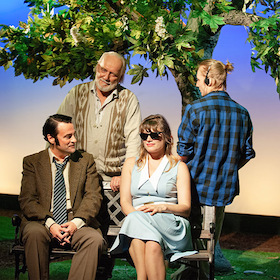
Atlanta, Georgia, 1948: Miss Daisy is a 72-year-old retired schoolteacher. After she causes an accident with her car one day, her son Boolie buys her a new one and hires the Black man Hoke Coleburn as a chauffeur just in case. Hoke, who at 60 is not the youngest himself, is a calm, life-wise man and thus the ideal counterpart to the egocentric Miss Daisy, who stubbornly refuses to utilize his services. With perseverance and undeterred by the old lady’s unkind remarks, Hoke eventually gets Miss Daisy to enter the car, and gradually a respectful sympathy develops between the unequal pair during their shared outings. What initially has the charm of a stubborn taming evolves into a social piece with depth and subtle overtones, without completely resolving the play of closeness and distance between the two main characters. There is enough explosive material for lasting tension in the real historical context from which the two protagonists stem, spheres that could hardly be more different: here the wealthy, educated Jewish Southern lady, there the black employee from the lower class in an era when racial segregation in the USA still almost inevitably determined people's daily lives.
»Ma'am, cars do not behave ...«
The play was a sensational success: already in 1988, the year of its premiere in Philadelphia, it received the coveted Pulitzer Prize. The Hollywood adaptation with Jessica Tandy and Morgan Freeman from 1989 not only drew millions to theaters worldwide but also won four (!) Oscars, including one for Best Adapted Screenplay. Besides the story, it is also the music that creates atmosphere. It allows us to immerse ourselves in the world of the legendary Deep South of the USA. Viewed through a magnifying glass, Miss Daisy and Hoke Coleburn provide insight into a difficult era, yet this is done in a warm-hearted, moving, and very entertaining manner. The author of the play, Alfred Uhry, hails from Atlanta and later worked primarily as a musical lyricist for Broadway productions. Uhry was inspired to write the play by his grandmother Lena Fox and her longtime chauffeur Will Coleman.

The play is part of a theater subscription, which will be sold starting June 21 at the KulTourBüro. Individual tickets available from September 23.