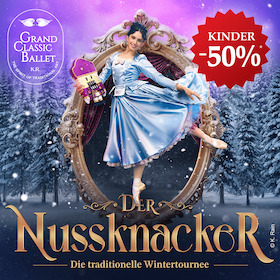
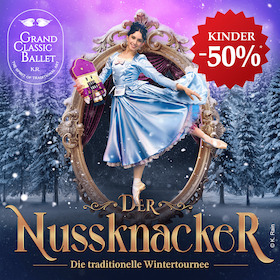
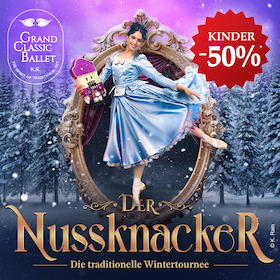
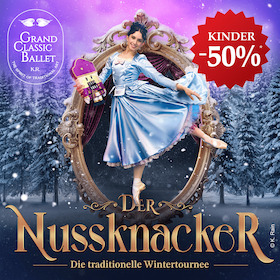
Der Nussknacker - Royal Classical Ballet
"Nussknacker" - about the plot:
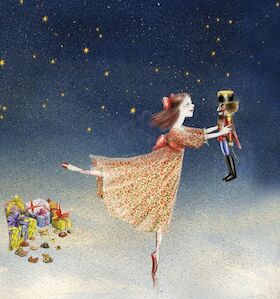
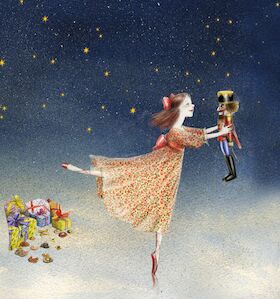
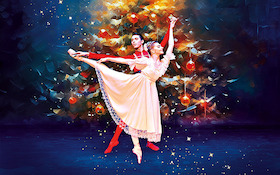
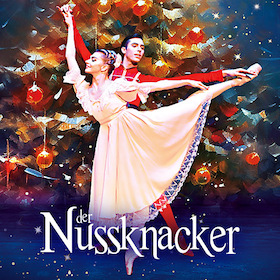
"Marie is eagerly awaiting Christmas Eve. Among many other gifts, she receives a nutcracker from her old, mysterious Uncle Drosselmeier, along with a dancing mechanical figure that particularly appeals to Marie's childlike imagination. Delighted, she falls asleep with the nutcracker in her arms under the Christmas tree. She has a strange dream. Uncle Drosselmeier makes the Christmas tree grow infinitely, and the nutcracker comes to life..."
The story takes the audience into a magical realm, where good and beauty reign, and where even as an adult, one wishes to return time and again. The fascinating splendor of the stage design and costumes, the fairy-tale plot, the music, and the dance complement this vital work full of romance, making the ballet evening a true celebration.
The libretto of the "Nussknacker" is based on the fairy tale "The Nutcracker and the Mouse King" by E. T. A. Hoffmann. This new theme for the composer, the discovery of the world by children on the threshold of adolescence, drew on ideas from the symphonic world and culminated in a lyrical-philosophical poem. The "Nussknacker", not particularly extensive according to conventional categories (only two acts), conceived as a puppet ballet for children, became a precursor to many phenomena of Russian ballet theater at the beginning of the 20th century due to the importance and richness of its content as well as its new form.
Regarding its creation, it is said that Modest Tchaikovsky arranged the tale of "The Nutcracker and the Mouse King," which had become widely known only in the last years of the 19th century, for his sister's children as a children's play. The composing brother Peter Ilyich was likely present at this family idyll. He reported this to his "Sleeping Beauty" choreographer Marius Petipa. Thus, the plan was born to turn this "Nussknacker" story into a ballet.
In the "Nussknacker," a new imagery enters the ballet: The characteristic drawing of the figure Drosselmeier and the kingdom of mice conveys a hint of "horror" as well as irony. The action dances are full of symphonic development: the growth of the fir tree, the Waltz of the Snowflakes, two Andante movements from Act 2, which radiate a special warmth, humanity, and lyrical fullness of feelings uniquely characteristic of Tchaikovsky.
Only with the year 1892 - a year before his death - did the premiered "Nussknacker" finally bring Tchaikovsky the long-anticipated success as a ballet composer among his contemporaries.
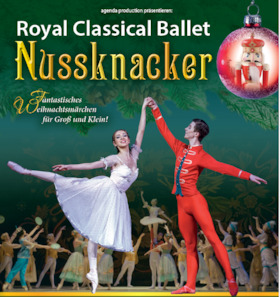
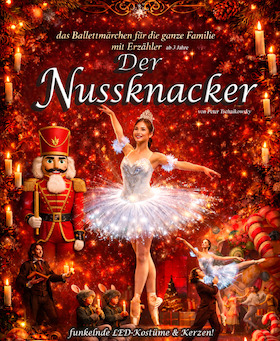
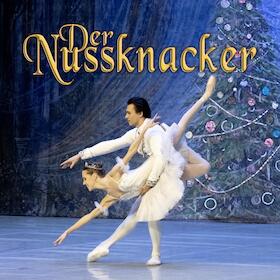
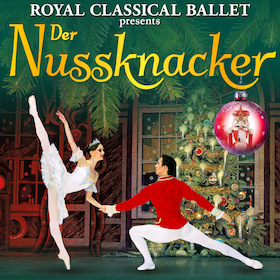
With floating lightness and elegance, the ballet dancers make one forget the exacting work and athletic rigor that lie behind the performance. With precise wing beats, the Royal Classical Ballet transports its audience into a world of weightlessness and poetry.
Ultimate perfection and impressive aesthetics combine to create a top-class ballet experience.
Each scene is vividly illustrated through narration, so that even the youngest in the audience can follow the danced scenes and the ballet's plot.
For young and old alike, it is a welcome opportunity to experience the unique perfection of ballet and effortlessly find access to the enchanting world of dance.
Admission: 1:00 PM

 Hallo, ich bin Maya.