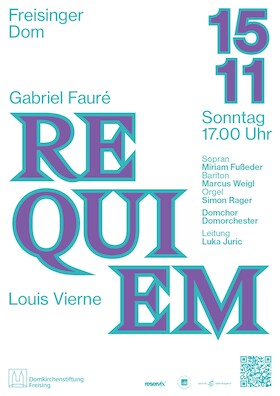
Gabriel Fauré Requiem - Benefizkonzert für das Palliativnetz Freiburg
Cappella Nova Freiburg e.V. will perform the work in the version for organ and choir under the direction of Katharina Skala. Featured performers include:
Natalie Beck, soprano, Uli Bützer, baritone, David Kiefer, organ
"After all the years during which I have accompanied funeral services on the organ, I know everything by heart! I wanted to write something different."
So commented Gabriel Fauré, * May 12, 1845 in Pamiers in the Pyrenees, + November 4, 1924 in Paris, on his Requiem. He wrote the work of his own accord, prompted at most by the death of his father (1885) and his mother (1887). On January 16, 1888, it was premiered on the occasion of the annual memorial service for the esteemed architect Joseph-Michel Le Soufaché in the Parisian church of St. Madelaine, where Fauré was then active as an organist and choir director.
… and Fauré wrote something different! He did not set the entire text of the then-standard Requiem mass to music. Initially, Fauré composed only 5 movements: "Introït et Kyrie," "Sanctus," "Pie Jesu," "Agnus Dei," and "In paradisum," written for a small choir with organ accompaniment. He added "Offertoire" and "Libera me" only in 1889. By 1894, Fauré continued to expand the instrumentation of the Requiem and, at the insistence of the publisher, released the Requiem in orchestral arrangement in 1901.
With the civic revolutions at the end of the 19th century in Europe, society's view of the omnipotence of the (Catholic) Church also changed. The fear of the horrors of the heavenly judgment, which only the "one true church" could protect against, gradually faded. Heaven has, above all, lost the horrors of purgatory. Accordingly, Fauré refrains from dramatically depicting the heavenly judgment, mentioning it only almost in passing.
It was to be a gentle Requiem, a lullaby of death. Fauré did not view death as a painful experience, but as a welcome liberation, a striving for the afterlife.
"Everything I possess in terms of religious imagination, I have infused into my Requiem, which is dominated from beginning to end by a very human feeling of faith in eternal rest." (Fauré)
His Requiem was also heard at his own funeral in 1924.
The concert evening will be complemented by motets by Karl Jenkins (* February 17, 1944).
16:30:00

 Hallo, ich bin Maya.