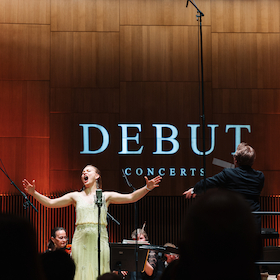
Saturday, 2/14/2026
at 8:00 PM


The following text was automatically translated.
Show original Show translation


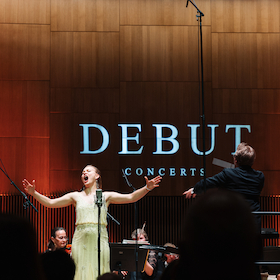
The Berlin singer and actress Nina Ernst found it too dark in Germany. That's why she moved to Brazil and made an amazing career there.

Her album "Nina Ernst canta Jobim" (Label: Fina Flor), recorded in the homeland of Bossa Nova, was not dismissed as presumptuous by local experts, but was praised in the highest terms. Several successful tours through the tropical country followed, during which she combined Brazilian music traditions with German pop classics from different eras in various shows.

But then came the pandemic, the great decelerator.

Where the whole world was previously colorfully dyed, light-soluble, sun-soluble, summer-soluble, suddenly an infinitely and eerily appearing darkness stretched out. But Nina Ernst, as a connoisseur of the brightly shining, multi-colored sun of Brazil, has long learned to appreciate the color of darkness as well. After all, without darkness, there is no light, no colors. Light and dark are not the same, yet they do not exclude each other. That is the ambivalence of bittersweet twilight. And because someone has to defend the darkness in the sparkle of colors, Nina Ernst uses this quiet phase to write new songs with her own lyrics around this comforting realization. Straight from the soul, they look mysteriously poetic and melancholically beautiful, but also humorously and cheerfully ironically at the world.
And yes, also at love, of course. This is at least as ambivalent as darkness. For example, Nina Ernst sees "The Window" looking at voids: "The window is old, it only observes as an eye in the ocean of time, it listens to the eternal ticking of the clock - and the window saw us once as two." But one does not let oneself be dragged down by that; rather, she "gives it to the men" or takes the willful sovereignty of cats as a model ("If I were a kitten"), while the notes cheekily snuggle into the ear canal like a cuddly house cat.

Musically, the German-language chansons incorporate various elements from jazz, oriental sounds, and classical vocal singing. And because the Brazilian ambivalence of "Saudade," that insatiable longing for the absent, captures the mood of many of her songs quite well, Nina Ernst also interprets two beautiful songs of her Brazilian singing colleague Mônica Salmaso, which were written by the composers Nelson Ayres and André Mehmari / Tiago Torres da Silva.

But even if the overall mood is more minor than major, "Dunkles Licht" does not wallow in heavy sadness. For Nina Ernst shows how even the dark can shine. How faces, how gardens, how thoughts can shine. They do so primarily in the reflection of the knowledge of the night. Sure, this night is potentially "cruel, dark, and cold" (as it says in the song "Your Garden"), but it is also a space of ecstasy, intoxication, and enjoyment: "In the dark light, I want to dance, want to see the full moon turning, I want to be intoxicated, want to buy as much gin as I can until everyone goes." So, the title song of the album "Dunkles Licht" sounds almost buoyant in the sparkling piano playing of her co-composer Tino Derado, who arranged the songs fluctuating between contemplation, saudade, and cheerful winks, and recorded them with other high-class jazz musicians. Nina Ernst shows that only dark light makes the colors shine. After all, the sea is the bluest when the sky is already thunderstorm black, but the sun still shines on the water from a gap. In a way, "Dunkles Licht" captures this phenomenon in text and tones. And that is indeed a very cheerful prospect.

(Text: Friedhelm Teicke)

Cast:
Nina Ernst: Vocals
Humberto Araújo: Wind instruments
Rolf Zielke: Piano
Mathilde Vendramin: Cello
Andreas Weiser: Percussion

https://nina-ernst.com/uber/

Photo: Gal Oppido

Box office opens at 7:00 PM

Event data provided by: Reservix

That might also be interesting

Nina Deissler - Das Schweigen der Männer - KölnPremiere
Die Nina Simone Story