Ach, diese Lücke, diese entsetzliche Lücke
After the tragicomedy WHEN WILL IT FINALLY BE THE WAY IT NEVER WAS (2023), which explores Joachim Meyerhoff’s childhood in a psychiatric hospital, the next novel in his successful autobiographical book series is now making its way to the big screen. In ACH, DIESE LÜCKE, DIESE ENTSETZLICHE LÜCKE, directed by Simon Verhoeven (WELCOME TO GERMANY), we follow bestselling author Joachim Meyerhoff, played by Bruno Alexander (THE DISCOUNTERS), through his years as a young adult—a period he spends with his eccentric grandparents and at the Otto Falckenberg School of Performing Arts in Munich.
The title may sound familiar to some: originally taken from Goethe’s “Werther,” this “gap” in Meyerhoff’s story is a metaphor for the emptiness left by his brother’s sudden death, and for the search for identity. What Joachim experiences as a young adult is something many people can relate to: feeling lost, searching for a sense of belonging while also striving for independence. The film taps into the most fundamental human emotions—skillfully and purposefully, across the full spectrum, and with great warmth and humor.
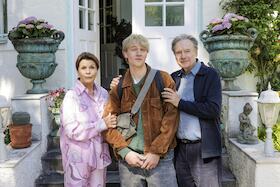
Although Joachim is rather quiet and introverted, and mostly observes the world around him, he decides on a whim to become an actor. His bewildered parents (once again played by Devid Striesow and Laura Tonke) are not exactly thrilled with his plan, but are glad their son has found a will to live. His grandmother Inge, on the other hand, is an actress through and through and also taught at the Otto Falckenberg School. Played with a touch of exaggeration by Senta Berger, every sentence Inge utters feels like a performance—distinctive, elegant, and out of time. His grandfather Hermann (Michael Wittenborn) is more the quiet type, a philosopher who spends his mornings absorbed in his writings.
So Joachim moves in with his grandparents in their large house, which has barely changed since his childhood. Inge and Hermann have their own, very loving marriage, with set rituals and a lifestyle that differs considerably from that of the younger generation. We see them through Joachim’s eyes: how he found their quirks fascinating even as a child, and how he still enjoys spending time with them as an adult. At the same time, the film shows how unsettling growing old can be, and how death lurks like a shadow in the dark—and yet still arrives without warning.
At the acting school, where Joachim is accepted against all expectations, they seem to see something in him. But he has to learn to let go, to transform his anger at the world and channel it into something artistic. He repeatedly clashes with teachers played by well-known actors (including Katharina Stark and Karoline Herfurth). At the same time, Joachim takes pleasure in watching his fellow students’ progress, bringing the theater itself into focus as well.
Time passes, and Joachim comes to know himself and his strengths better. This is probably the very period that shaped him into the author he is today. Simon Verhoeven strikes a balance between tragedy and comedy. Again and again, it becomes clear that this is not just about Joachim, but also about the people around him, who are dealing with crises of their own. In the end, this is a film about the way life sometimes unfolds: with wit and with moments that can bring a tear to almost anyone’s eye.
Doors open: 7:30 p.m.

 Hallo, ich bin Maya.