Andere Welten – Drei Zukunftsromane
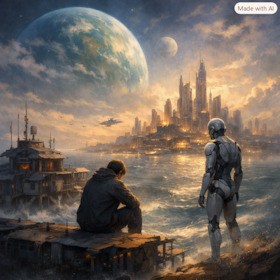
Ein Android, der einen Freundeskreis spaltet. Ein Wohnblock, den der Wind aufs Meer treibt. Ein Student, der den Weg zu einem fremden Planeten findet. Drei Autoren, drei verstörend nah wirkende Zukunftsvisionen – präsentiert an einem Abend voller Zündstoff im Weinheimer Feuerwehrzentrum.
Sebastian Schmidt: „Powerschaum“
In einer nahen Zukunft: Sascha sitzt allein in einer Boutique. Seine Freund*innen haben ihn dort eingeschlossen, denn er soll ein Verbrechen begangen haben, über das sie Rechenschaft fordern. Vor geraumer Zeit hatten sie Neuzugang in ihrem Freundeskreis. Der Android Charly lebte als „Testlauf“ bei Saschas Freund Jan und verhalf diesem zu finanzieller Sorglosigkeit. Er brachte sich zunächst mit neuen Ideen für Unternehmungen ins Spiel, wirkte überraschend zugänglich und wurde von allen gemocht. Nur Sascha blieb skeptisch und traute Charly, „der ja kein Mensch war“, nicht. Es war weniger dessen technische Physis, die Unbehagen auslöste, als das Aufzeigen und Vertiefen gesellschaftlicher Zwischenräume und Abgründe, die sich im Freundeskreis reproduzieren. Die Leser*innen wissen von Anfang an, dass das Ganze schlimm enden wird, doch was passierte dann eigentlich? Wie kam es zu der Eskalation? Und welche Rolle spielte Sascha in all dem? Erzählerisch um permanente Gegenwart bemüht, schreibt er „jetzt gerade“ eine Rückschau, die nicht nur die Ereignisse der jüngsten Vergangenheit rekapituliert, sondern auch die eigene Kindheit erinnert. Ein Gesamtbild entsteht durch Schilderungen der prekären Situation mit seiner Frau Elodie und den Kindern und des von unterschiedlichen sozialen Herkünften geprägten Freundeskreises. Sebastian Schmidts Debütroman Powerschaum ist Science-, mehr aber noch Social-Fiction.
Sebastian Schmidt, geboren 1983, ist aufgewachsen in und um Heidelberg. Er schreibt Prosa, Lyrik und Essays. Als Mitglied des Netzwerks Other Writers Need to Concentrate setzt er sich kritisch mit dem Thema Care-Arbeit und Schreiben auseinander. Texte des Autors wurden ins Tschechische, Französische und Englische übersetzt. Sebastian Schmidt lebt in Würzburg.
Patrick Beck: „Windheim“
Plötzlich riss der Wind den Block los, trieb ihn aufs Meer hinaus. Niemand konnte mehr fliehen, das passierte mitten in der Nacht, als wir geschlafen haben. Wir haben geschlafen und für uns ist der Block weiter in seinen Fundamenten gestanden. Eine seltsame Erfahrung ist das für uns gewesen, als es hell wurde und wir aus dem Fenster geblickt und erkannt haben, dass nur das Meer um uns war, kein Land weit und breit, nur Wasser, Wellen, Wind. Und da ist uns klar geworden, dass wir mitten auf dem Meer trieben, dass wir in einem Haus mitten auf dem Meer trieben... Die Idee zu diesem Buch entstand in Marseille. Der Himmel war strahlend blau, der Mistral wehte über mehrere Tage hinweg. Ein so starken Wind über eine so lange Zeit – das war neu für mich. Der Wind war so stark, dass die Fähren zum Chateau d’if nicht fuhren – die Festung, in der der Graf von Monte Christo eingekerkert war. Man musste aufpassen, dass man nicht über seine eigene Füße fiel, der Wind drückte den einen Fuß vor der anderen. Marseille ist auch die Stadt der Cité Radieuse von Le Corbusier. Eine Wohnmaschine, die man nicht mehr verlassen muss – ausgestattet mit Restaurant, Schule, Einkaufsetage usw. Wind und Wohnmaschine fügten sich von selbst zu einer Idee zusammen. Ein merkwürdiger Wind schließt die Bewohner eines Wohnblocks auf Jahre ein.
Patrick Beck: 1975 in Zwickau geboren, lebt nach einem Jurastudium und Aufenthalten in Leipzig, Speyer und London in Dresden. Lyrik, Essay, Drama. Im LLV sind von Patrick Beck bereits erschienen: Swantegard (Hörstück), Ich habe ein Haus aus Licht gebaut (Roman).
Rolf Thum: „Elysium – Die neue Erde“
Der Planet die „Neue Erde“ scheint ein wahres „Elysium“ zu sein, denn fünf intelligente Spezies leben seit Jahrtausenden auf ihm in Harmonie und auf einem technologisch sehr hohen Niveau: Kommunikation per Telepathie gehört für seine Bewohner zum Alltag. Auf unserer „Alten Erde“ dagegen schreibt man das Jahr 1980, kennt man weder Internet noch Smartphones, sondern freut sich gerade über die ersten Computer.
Der Ich-Erzäher der Geschichte, ein Heidelberger Student, von dem wir nur den Spitznamen „Rolli“ erfahren, findet zufällig in einer wissenschaftlichen Abhandlung über Astrophysik die Landkarte eines fernen Planeten, die genauso aussieht wie die Karte seiner Fantasiewelt aus der Kindheit. Entsprang diese Welt vielleicht gar nicht seiner Fantasie, sondern war Wirklichkeit? Wie aber gelangt man zu ihr, da doch Reisen durch den Weltraum zu fernen Sternen (bislang) unmöglich erscheinen? Er trifft den Autor der besagten Abhandlung und dieser versucht ihm glaubhaft zu machen, dass es einen Weg zu dem anderen Planeten tatsächlich gibt und Rolli in seiner Kindheit dort gewesen sein muss. Tatsächlich findet sich dieser Weg erneut, wobei eine Katze eine nicht unbedeutende Rolle spielt.
Rolf Thum wurde 1952 in Heidelberg geboren. Nach seinem Studium und der Promotion an der Universität Heidelberg im Fach Mineralogie/Geologie war er zeitweise in der Industrie und einem Entwicklungsprojekt tätig. Später war er Forschungskoordintor für die Hochschulen für Angewandte Wissenschaften in Baden-Württemberg. Seit 1993 hat er einen eigenen Verlag mit dem Schwerpunkt Reiseliteratur. Er ist verheiratet und hat zwei Töchter. Rolf Thum lebt in Hockenheim.
Einlass ab 18:30

 Hallo, ich bin Maya.