GEORG KREISLER: UNHEILBAR GESUND
From the series "Berlin Stories"
GEORG KREISLER: UNHEILBAR GESUND
A musical evening
Book and direction: Barbara Abend
Musical arrangement: Ute Falkenau
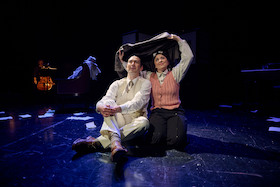
With: Carl Martin Spengler (Acting, Singing) and Peter-Philipp Röhm (Piano)
Duration: approx. 1h 45 min. (including a 1 intermission after 50 min.)
PREMIERE was on 11.10.2019 at the THEATER IM PALAIS Berlin
Under the title GEORG KREISLER: Unheilbar gesund, the proven team that already celebrated successes with the Otto-Reutter evening has once again selected a brilliant stage author.
Carl Martin Spengler and Peter-Philipp Röhm, under the direction of Barbara Abend, dedicate themselves to the great Austrian.
Georg Kreisler was a genius, a literary-musical genius that likely will never be seen again.
What he wrote and composed was not cabaret, nor were they chansons. It was so much more than poetry and literature. There is no term for it, except perhaps the title of one of his records: Kreisleriana.
He could juggle melodies and musical styles as he wished. With words, of course. His songs are always multi-dimensional... he could be grotesquely punning and silly while being deeply sad, he could sharply criticize while always being witty.
(Eva Menasse, Writer)
When mentioning his name - Georg Kreisler - the response is immediate: “Poisoning Pigeons in the Park.” In the catalog of his 500 song creations, this song received harsh criticism and toxic rejection in the Viennese media upon his return from exile.
Born in Vienna, at the age of fourteen, he shared the fate of the Jewish inhabitants of Vienna who were lucky enough to obtain an emigration permit to the USA in 1938/39 at the cost of their property.
After a short childhood in Vienna, fleeing with his parents across the ocean, the breakthrough came in New York and eventually the return to a foreign Austria that always made him shiver - The 20th century turned Georg Kreisler into a rootless person “who found his home in art and in language. He was a genius that will never be seen again.” (Atrium Verlag Zürich)
He lived in Berlin for 10 years and had readings and performances of his stage works, his celebrated evenings at the leading cabarets in Berlin, the “Wühlmäusen” and the “Stachelschweinen,” a productive contact with the interpreter Tim Fischer, a style-defining Berlin (theater) history.
Over 500 songs, novels, essays, short stories, plays, and operas - he left behind an incredible body of work.
Entry at the box office / theater bar 60 minutes before the performance starts.